Tuesday, 24 February 2009

Why The Satellite?

A noctuid moth turned up on the kitchen window yesterday that was identified (after some difficulty) as a satellite (Eupsilia transversa).

The English name comes from the small spot on each forewing which has usually two satellite spots beside it.  In this close up picture one satellite is quite clear, but the other, to the south west of the orange main spot, is very faint.

20090224 South View 009

The moth is quite common in the British Isles and overwinters as an adult.

Tuesday, 3 February 2009

Spurge wood

The sudden heavy fall of snow has highlighted the young spurge plants that came up last year.  They are an exotic species that has appeared around the garden for many years and, when they flower, I shall have to make a concerted effort to work out their identity.  Clearly, their leaves are quite efficient at shedding snow.

20090203 Kwr snow 015

Tuesday, 13 January 2009

Early moths

Two moths have appeared in KWR so far this year - a male winter moth and, yesterday, a cow-parsnip flat-body (Agonopterix heracliana), a species I have not come across before that must have been tempted out of hibernation in the mild weather that followed an extremely cold spell.  It is, however, a common species, though there are few records on the Sussex Biodiversity Record Centre's database.

Thursday, 20 November 2008

Fallen leaves & feathered thorns

Many leaves have blown into the Kitchen Window Reserve over the last several weeks and I have decided to leave them and watch their progress and the effect they have on other plants.

20081115 KWR autumn leaves

Although we have had a couple of frosts, the large and rather beautiful feathered thorn moths (Colotois pennaria) have been quite common over several week period with one or two appearing regularly on the lighted windowpanes.

20081120 Kvr feathered thorn

Saturday, 13 September 2008

Hoverflies & corn-salads

Some good things on a rare sunny day.  Two hoverflies were feeding on ivy blossom: the drone fly (Eristalis tenax) and the much scarcer common bog hoverfly (Sericomyia silentis) pictured below.

20080913 KWR Sericomyia 002

20080913 KWR Sericomyia 003

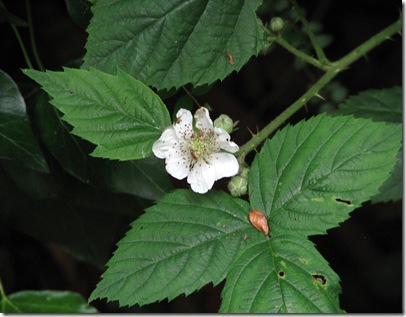
I also noted the first mine, in a bramble leaf, of the golden pigmy moth (Stigmella aurella).

On the flora front I have decisively determined the corn-salad plants that continue to flower into the autumn.  They are all keel-fruited corn-salad (Valerianella carinata), a relatively scarce species and not, perhaps, one that would have been expected.

In examining the seeds under the microscope, I noticed that many had been broken into via a jagged hole on one side and the kernel eaten.  Perhaps a small beetle - I must try and find the culprits.

Valerianella carinata in flower, South View 20020928 f

Friday, 18 July 2008

Great Oak Beauty, Hypomecis roboraria

This moth is a great oak beauty (Hypomecis roboraria) and Nationally Scarce (Nb) species with its main strongholds in England in wood areas in the south east.

20080715 005

This was on our lighted kitchen window pane and, in this underside view, the diagnostic pale spots with dark surrounds at the wingtips are clearly visible.

The moth is widespread across Sussex, though less so in the east, and the larvae, as the English name suggests, feed on oak.

Wednesday, 11 June 2008

New rock

9 June 2008.  Among the scatter of seedlings now apparent in the bare areas of KWR, there are one or two grasses (which may vary what currently seems to be a monospecific grass population).

I identified a moth caught on the lighted window the other day as the pale clothes moth (Tinea pallescentella).  It is considered by some that, because this moth was unrecorded in Britain before 1840, it may have been imported from Patagonia (it turned up in other countries outside South America at round about the same time).

Curiously, later in the evening, I found another moth on the lighted window.  It was a fulvous-tipped clothes (Tinea semifulvella) and this is the next moth covered after T. palescentella in moth book (Pelham-Clinton in Heath & Emmett, 1985)

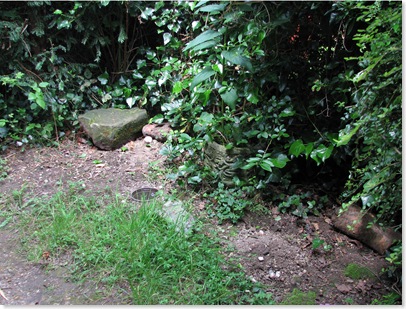
10 June 2008.  The highlight of today was the transportation of a large sandstone rock from under the bird cherry on the south west corner of the house to KWR.

I know from my experience with other rocks that it is best set with a slight slope to the flat upper surface so that dropped or voided seeds can be washed off into the well-fertilised soil below.20080610 South View 003
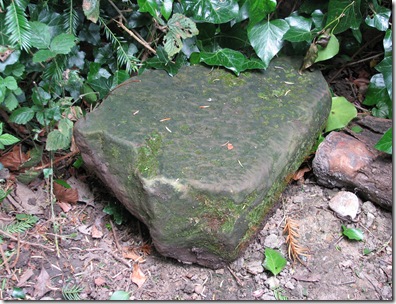
The stone has small indentations on one surface indicating that it has been dressed as masonry at some time.  We think it came from Oaklands Park to the south of the village maybe the early 1960s.
20080610 South View 001

20080610 South View 004